
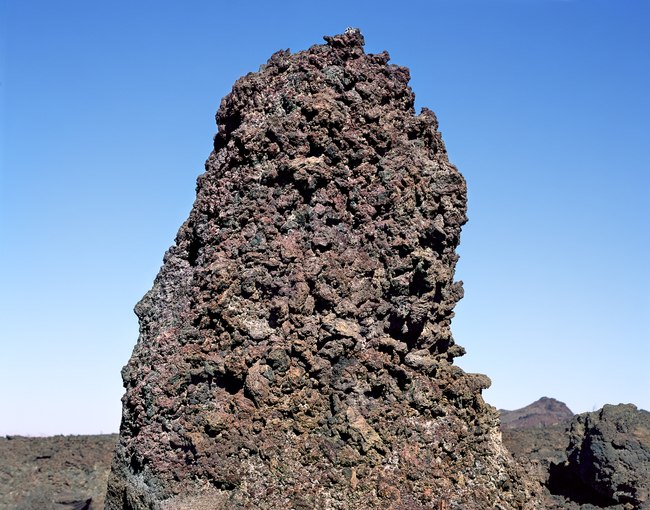
There was no discernible path through this volcanic field in northwestern Mexico's desolate El Pinacate. While traversing this rugged terrain strewn with sharp rocks, I had to climb over and step around numerous cavities, risking getting stuck. My progress was slow and cautious, and with each step, I had to carefully adjust my balance.
An unexpected benefit of my slow progress was that, out of necessity, I had to focus on the details of what became a strangely alluring territory. It felt primal. The Earth's burning interior literally reached out toward space, then was cooled by water and air into a crust. Described as a wasteland, 19th-century European explorers found the Sonoran Desert inhospitable; it was (and to some extent still is) terra incognita to everyone except the Tohono Oʼodham tribe, who hold their homeland in reverence.
Eruptions began four million years ago, forming this region's lava flows and volcanic peaks due to dramatic shifts in the Earth's crust along the San Andreas Fault, less than 100 miles to the west. Multiple times, molten lava moved across the landscape. Its surface solidified into loosely packed, highly irregular fist-sized clinkers (fused, cooled, and hardened lava), while underneath, hotter, fluid magma carried them along.
This tower formed in one of two ways: either from a flow that was pulled apart by shearing and twisting, then piling up on itself. Or the molten flow was forced up through an opening in its partially hardened surface, accumulated around that opening, and the clinkers became glued together by the hot, pasty lava. Over time, the formation solidified, weathered, and its surface oxidized from jet-black to reddish-brown. The raw landscape over which it rose has otherwise remained remarkably unchanged since its creation.