
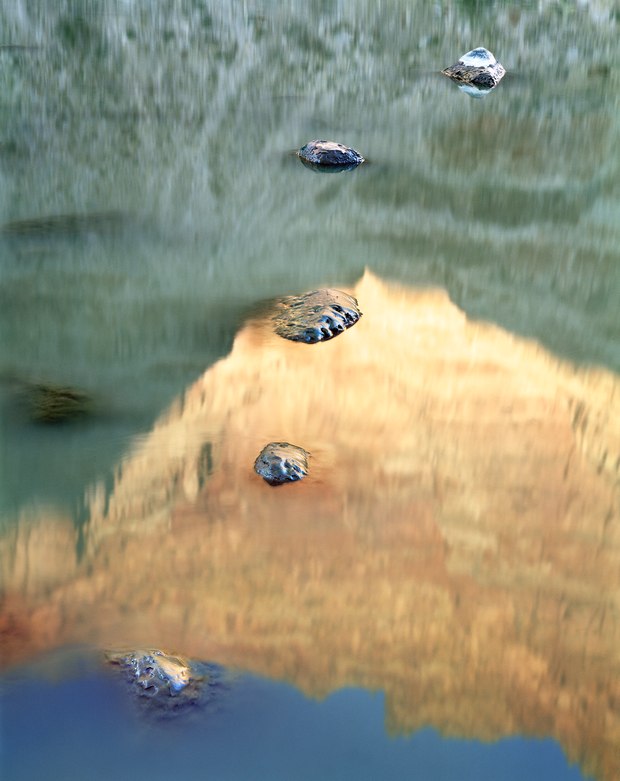
The Colorado River originates on the west slope of Rocky Mountain National Park. It flows 1400 miles to Mexico’s Gulf of California, although it no longer reaches the ocean due to irrigation diversions. Halfway along its route, the silt-filled river runs through Utah’s deep Cataract Canyon, slow-flowing stretches alternating with, according to its name, white-water cataracts.
This part of the river has numerous rapids, most often dammed by rocks purged from side canyons by flash floods. Further downstream, the Colorado is blocked by Glen Canyon Dam, which, ironically, transformed the lush Glen Canyon into a desert reservoir, Lake Powell.
Twenty years ago, in the early light, I photographed along the riverbank at Ten Cent Camp, where our river trip had pitched tents the previous evening. The new day’s first rays illuminated the canyon rim. In the pooled water above Imperial Rapids, reflections from the canyon walls highlighted mud-coated stones.
From our campsite, I could hear the roar of Cataract Canyon’s final rapid. For many years, it was drowned by Lake Powell. After a severe drought in 2002-3, the lake level dropped, and the arduous chute reappeared.
Of this stretch of river, explorer John Wesley Powell wrote in 1869, “From the edge of the water to the brink of the cliffs it is one thousand six hundred to one thousand eight hundred feet. At this great depth, the river rolls in solemn majesty. The cliffs are reflected from the more quiet river, and we seem to be in the depths of the earth, and yet can look down into waters that reflect a bottomless abyss.”