
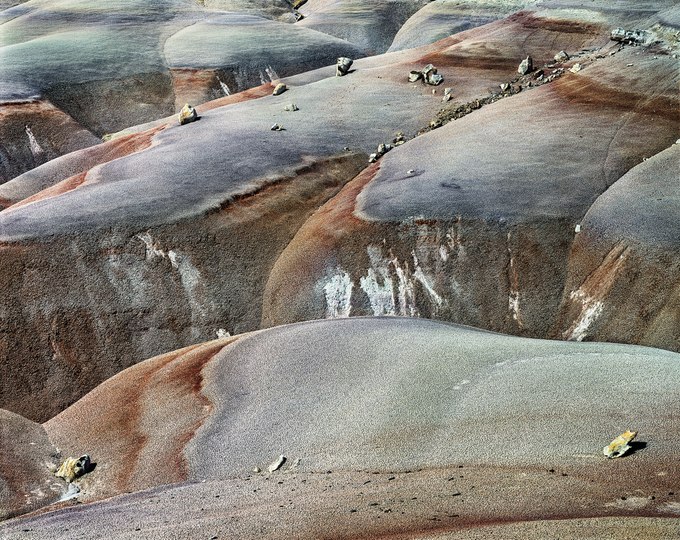
Central Utah is a wild, desolate, untamed landscape. Outcrops of the Morrison Formation—laden with dinosaur bones and plant remains—stretch from New Mexico to Alberta, Canada. Sedimentary layers of clay, silt, sandstone, and volcanic ash were once deposited by rivers across floodplains. Uplifted by movements of the Earth’s crust into a desert plateau, these steep, smooth slopes are striped with colorful bands of gray-green, reddish-brown, and purple.
Underfoot, this land’s crunchy, popcorn-like texture results from repeated wetting and drying of the formation’s volcanic ash (bentonite). When dry, the hardened surface shields the soft clay. When wet, the clay expands into a slurry that is impossible to walk across or drive over. In any weather, exploring this territory is a test of patience; the unstable soil slips beneath hiking boots. Under the summer sun, its slopes become unbearably hot. Not surprisingly, this territory is rarely marked by visitors' footsteps, though I love tracking through its otherworldly beauty.
The clay’s perpetual contraction and expansion, along with its high salt content, make it impossible for plants to take root. With its soft, loose clay, the Morrison Formation is eroded by infrequent but strong summer thunderstorms. Littering its multihued slopes are broken ledges of warm-toned limestone, evoking the backgrounds of the long-running 1950s and 60s television series Death Valley Days, which was, in part, filmed in these canyonlands.