
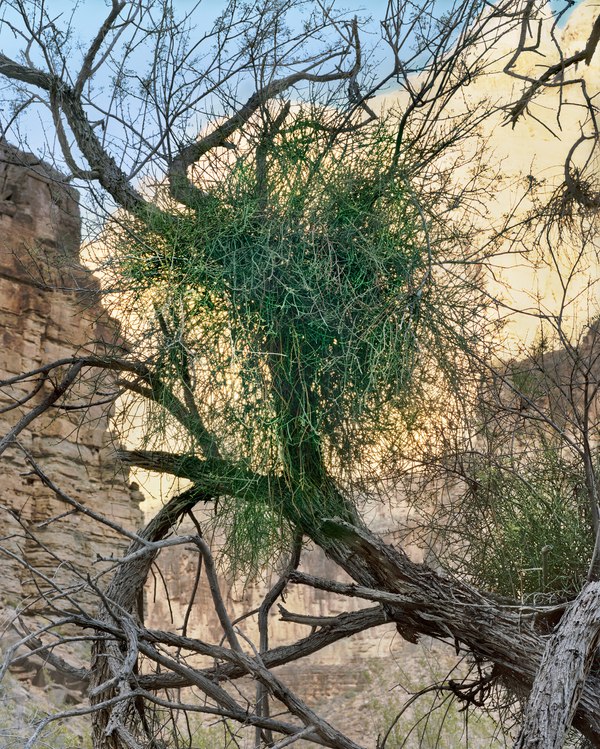
Camping along the Colorado River during the final days of a Grand Canyon river trip, I hiked up a narrow, dark side canyon along Parashant Creek, a short distance from the river. In that early spring two decades ago, the creek, a major yet seasonal tributary of the Colorado River, was already bone dry. Deep in a sheltered ravine, an old mesquite tree grew, its shaggy branches tipped with blossoming buds.
A loosely raveled tangle of green thread, thriving on its ancient host, nestled between its limbs. Mistletoe found in northern Arizona’s Grand Canyon is in many ways very different from the type used for the Yuletide tradition of kissing under the mistletoe. However, all members of the species share one thing: they germinate on and grow directly from tree branches. In the desert Southwest, they attach to acacia, ironwood, and mesquite trees, sending their roots beneath the bark to access nutrients. Its genus, translated from Latin as “tree thief,” can weaken a tree, though it rarely kills it.
Its red-purple berries provide food for birds, and indigenous people used the sweet fruit for food and medicine. While the plant itself is toxic, the desert mistletoe’s berries are edible for humans, unlike those of other varieties, which are poisonous. It also provides nesting for the Phainopepla, a desert flycatcher that is the most common ‘planter’ of desert mistletoe. It eats its berries and quickly processes them, leaving sticky, undamaged seeds on tree branches where it can flourish and grow.