
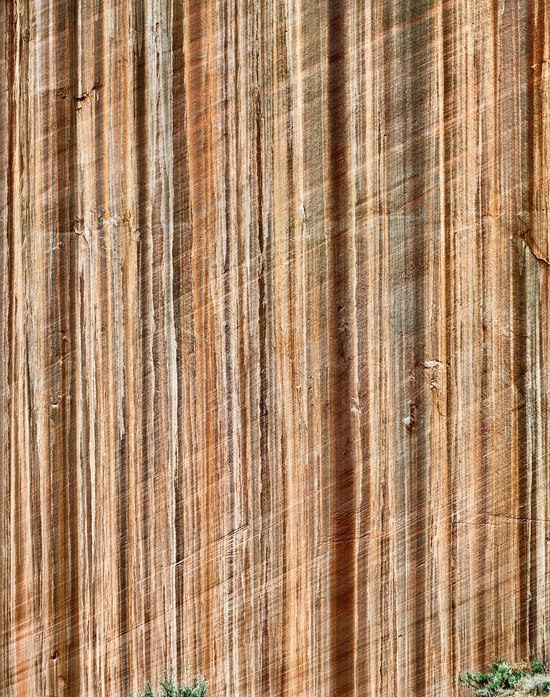
Hiking the serpentine stream trail in south-central Utah's Escalante Canyon, I marvel at its uniquely striped, painted walls. They remind me of a type of abstract painting Helen Frankenthaler developed in the early 1950s, when she soaked canvases in turpentine-thinned paint. Influenced by Frankenthaler, Morris Louis poured these dripping colors onto tilted canvases, letting gravity draw them down in lines that mimic how this canyon’s sheer face was coated.
Over time, erosion-resistant sandstone became covered with clay dust streaked with minerals, bacteria, and fungus dissolved by rain, creating a range of tones and colors. Together, these elements form a varnish on shaded north- and east-facing walls, where moisture supports the very slow, long process of its formation. Beneath the surface veneer, thin diagonal lines from ancient, tilted dunes, now lithified into sandstone, are visible. Rain trickling off the canyon’s rim adds thin, pale streaks of sediment over the patina.
As I move through this vast passageway, the colorful, strangely evocative crags create an almost cinematic experience. My perception keeps shifting as reflected light curves through the canyon, highlighting frescoed cliffs and casting shadows across its secluded alcoves. It is, at once, somber and lively. Somber because of the enormous scale of this dark precipice, hundreds of feet deep, and lively because of rock faces where the choreography of lines and colors dance together.