
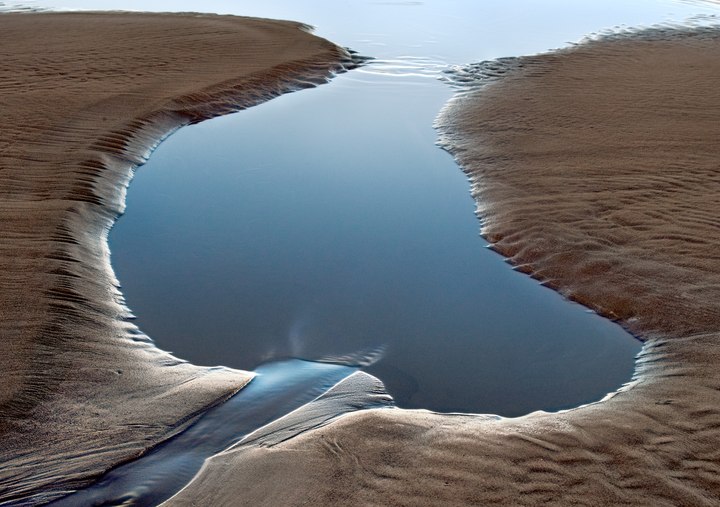
Water drains from beneath Lincoln Beach’s bluffs, forming meandering streams that cross the wide sand beach to reach the Pacific Ocean’s shore. The resort city, named for its famous beach on Oregon’s northwest coast, faces west. In this photograph, the water’s edge catches the afterglow of the setting sun during a “King Tide.” Caused by the gravitational pull of the sun’s low winter-solstice angle, a full moon, and the Pacific Ocean’s winter storms, this type of tide rises higher and falls lower than usual. At low tide, more of the ocean bed is exposed, highlighting ripples in the sand left by waves and currents.
The resort, in effect, began in 1837, when two couples arrived by horseback from the Willamette Valley to celebrate their honeymoons, a generation after the 1806 encampment of the Lewis and Clark Expedition, a hundred miles north of this beach. They bathed in the ocean, dug for clams, baked fish, and recorded in their journals that their health improved after several weeks of sun and sea air.
They wrote that they loved the untrammeled feel of the beach. Until then, this part of the coast was inhabited solely by the Siletz, Yaquina, and Alsea peoples. For at least 10,000 years before the newlyweds arrived, settled villages along the river bays and on the ocean thrived in the favorable climate and abundant food sources.
Today, residents and tourists, knowingly or not, continue these older traditions, relaxing along the shoreline, swimming, digging for soft-shell clams, and grilling surf perch over beach fires. On this chilly evening, though, the cinder-sand beach bore only my footprints.