
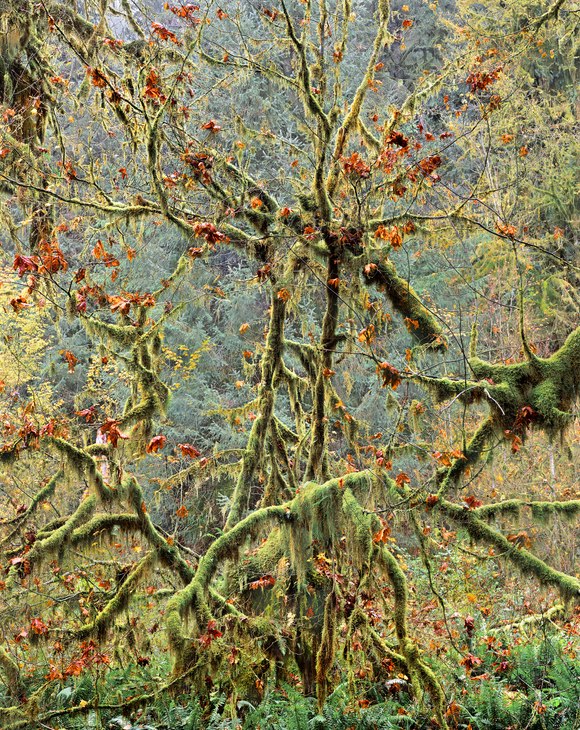
On my first visit 30 years ago, when I entered the Hoh Rainforest, I realized that despite the wind, cold, and very wet conditions, late fall is the best time of year to experience western Washington’s Olympic Peninsula. November is one of the wettest months in the Pacific Northwest. It’s when the moss-covered growth of this primeval forest is most alive and vibrant. The drenched air saturated me.
During the short daylight hours of late autumn at this northern latitude, my long drive to the forest made my visit brief. Hastily walking the Hall of Mosses trail, I passed ancient towering cedars, firs, spruces, and hemlocks. On a recent visit, I noticed the forest had thinned; many old giant trees had long since fallen.
At the edge of the grove stood a vine maple, usually about the size of a large bush, though this massive plant nearly reached the height and girth of a tree. In autumn, its leaves turned a strikingly rich shade of orange-red, contrasting with the soft blue-green of the conifers. Its bark was coated with mosses and lichens, lending an ethereal appearance. At the same time, overgrown and tangled, the stretch of its tentacled branches resembled an ominous and brooding creature, ready to reach out and encase me.
Vine maples typically grow where a large tree in the grove has fallen, allowing sunlight to support this fast-growing plant. Dominated by conifers, the presence of vine maples further promotes the growth of this ancient forest by bringing nutrients to the surface. Although long-lived for deciduous trees, this withering tree has since fallen, having decayed into humus and, in so doing, nourishing other plant life.