
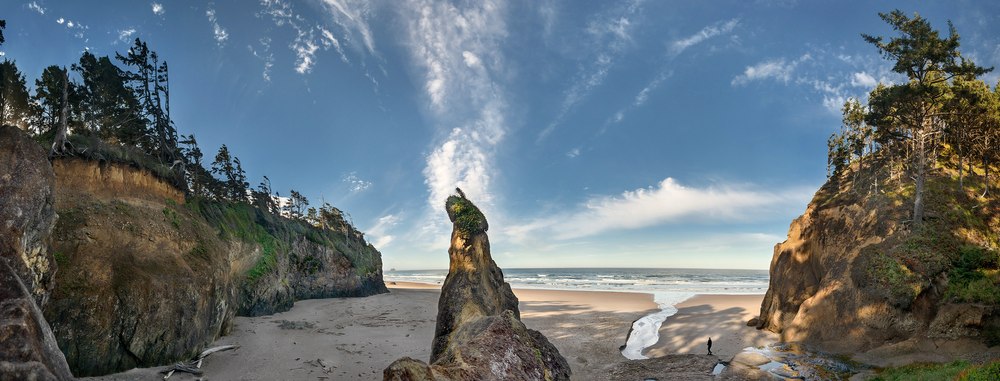
A calm sea and crystal-clear air followed an early autumn storm that announced the change of season with gales, rough seas, and heavy rainfall after a dry summer. The storm refilled Fall Creek, which crosses this wave-smoothed beach on its way to the Pacific. Ribbons and flecks of cirrocumulus clouds stretch across the deep blue sky, giving it an almost nighttime appearance.
The creek runs over a volcanic rock shelf — shown in the lower-right corner of the photograph — and then descends directly onto the beach. It is a rare geologic feature located on a stretch of the northern Oregon coast composed of ancient sandstone and basalt. This mixture of rock types — along with changing sea levels over millennia, shifting tectonic plates, and the continual assault of winter storms — has contorted the shoreline, leaving a collection of remarkable sea stacks, spires, alcoves, and caves.
Native tribes and 19th-century settlers once used the long coastal beach when traveling from the Columbia River to coastal settlements farther south. The colorful, iron-stained headland to the right blocked passage along the beach except at low tide, when travelers had to ‘hug’ the headland to get by.