
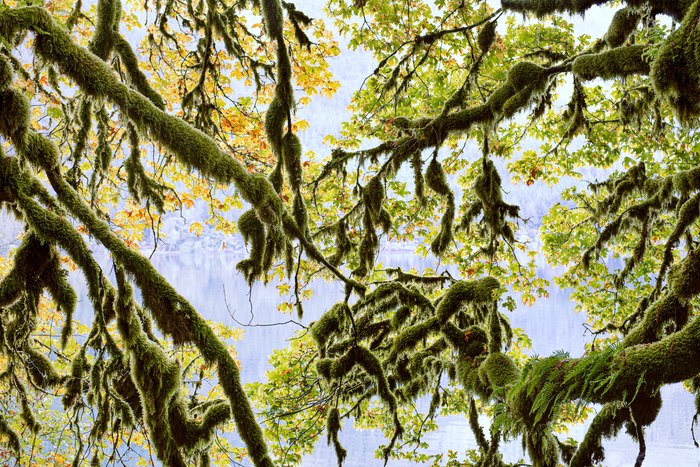
Route 101 runs along the south shore of Lake Crescent in Olympic National Park. Always eager to reach the Hoh Rain Forest or the coast to photograph Second Beach near La Push, I used to speed along this winding highway, unaware of what surrounded me. One day, as I drove by the lake, I spotted a broadleaf maple whose branches bent down and touched the lake’s surface. It was covered in a thick layer of spike moss, nourished not by the tree itself but by rain and nutrients collected from the air.
The lake is pristine, deeply carved by glaciers and dammed by a landslide several thousand years ago. It is cold, clear, and deep, with an iridescent blue-green hue characteristic of a glacial lake. This coloration is not due to suspended sediment but to its cold temperature and the lack of nutrients needed to support most aquatic life. Later, this area became a favorite of my family and me, with the stunning lake, the beautiful Crescent Lake Lodge built in 1916, Sol Duc Hot Springs and old-growth forests nearby.
Over time, with each return visit, the aging tree has gradually leaned toward the lake and begun to sink. The water slowly dissolves the branches, limbs, and trunk as they settle, rot, and disintegrate. This maple, like everything in nature, is a temporary feature—my act of photographing became a last chance to preserve an image of this fully grown tree as it began to complete its arc of growth and life.