
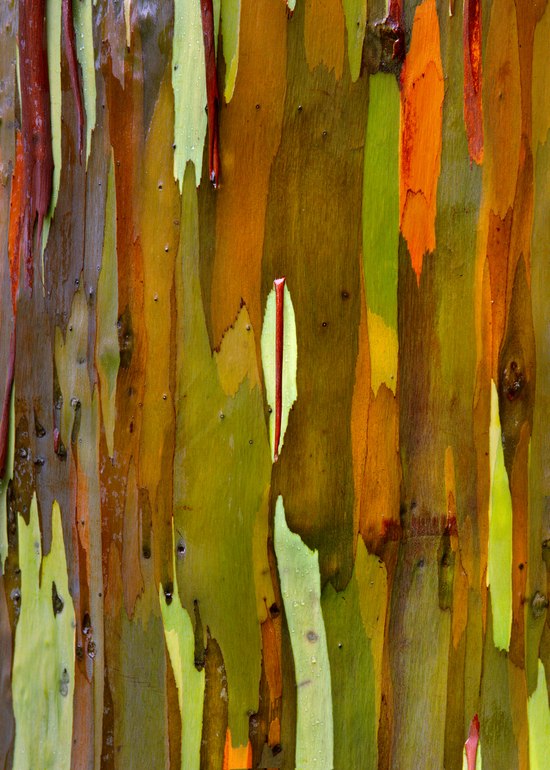
Visiting the Keahua Arboretum near the center of Kauai, I discovered a forest reserve dedicated to the study of indigenous plants—now mostly extinct elsewhere on the island—and to plants introduced to the Hawaiian Islands by migrating Polynesians beginning in the 4th century. The first rainbow eucalyptuses were brought to the islands a century ago.
What caught my attention was their thin, smooth brown-gray bark, which naturally peels throughout the year. A strip of shed bark reveals a pale green undercoat. Over time, sun and rain turn the torn strips into colorful stripes that gradually darken and shift through a spectrum of red, orange, purple, and blue-gray hues. Despite their name, these are, of course, not the colors typically associated with rainbows, but they are equally kaleidoscopic. This effect is especially pronounced after a rainstorm of unusual intensity, like the one I experienced when I visited this grove, when the bark became saturated and, with it, its colors.
Though the downpour left me soaked, what it revealed was extraordinary. Beyond the delightful spectacle, the ripped, vibrant trunks reminded me of pieces of Clyfford Still's paintings. An early proponent of Abstract Expressionism in the 1940s and 1950s, Still's mature work by the late 50s was as recognizable as, say, Mark Rothko's among painters, critics, and museum curators (if not by the public). His painting style produced dramatic contrasts—colors tearing through each other—symbolizing, in his view, the struggle of "life and death merging in a fearful union."