
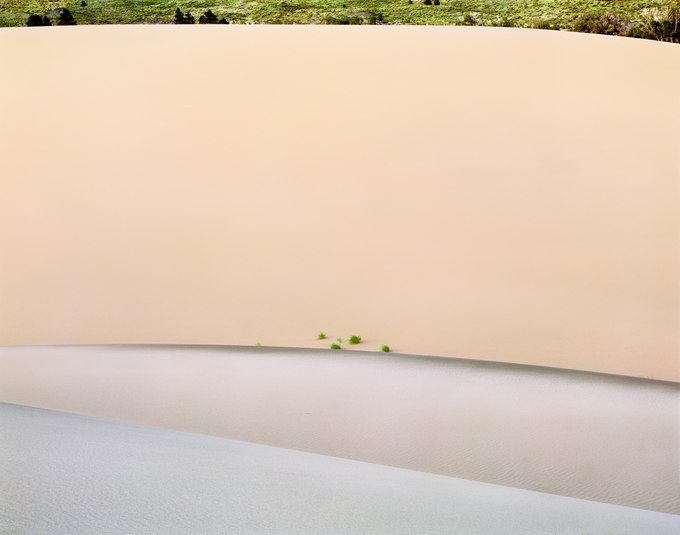
On the eastern edge of southern Colorado's Great Sand Dunes National Park lies the windward slope of a large dune, where the prevailing westerlies have built a high crest. Following seasonal cycles, spring snowmelt drains down creeks from the high country, carrying sand from the east side of the park to its western boundary. In summer and fall, dried, loose sand is blown back into the dune field.
Water stored deep within the dunes moistens its basins year-round, feeding Scurfpea, the most common leafy plant in these damp hollows. Beyond the dune's edge lie grassy fields and stands of conifers and cottonwoods that cover the foothills of the Sangre de Cristo Mountains.
Dusk displayed a color spectrum the evening I made this photograph decades ago. The sandy, west-facing slope reflected the saffron warmth of the setting sun, while the shaded foreground subtly caught cooler tints of magenta and cyan from the sky's twilight glow.
I experienced the vast sand fields as a walking meditation. As I traversed the undulating dunes, I watched them change, the landforms shifting into sinuous configurations as I wandered through spaces shaped by sand and wind. I got lost among its basins and slopes until I crested a ridge, took in its enormity, and began to better understand the elegant patterns of this terrain.