
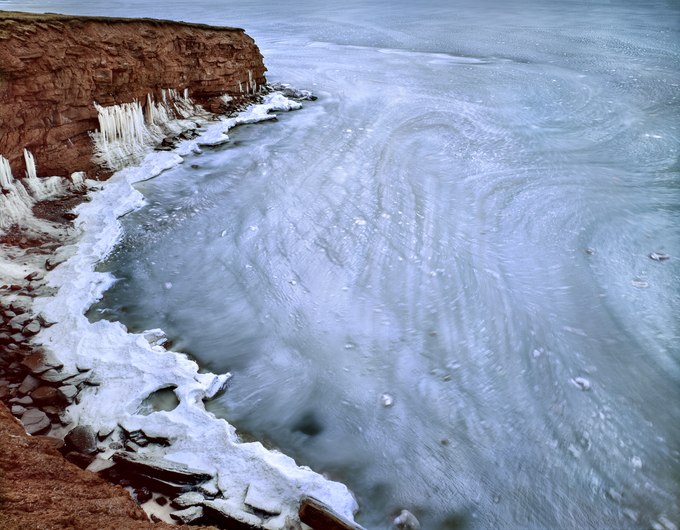
Damp, windy, and cold are the adjectives that best describe Prince Edward Island's winters. An eastern Canadian province in the Gulf of St. Lawrence, it is renowned for its sublime summers. However, from November through April, sea ice often covers much of the gulf's waters, attaches to its beaches, and coats the cliffs along its coastlines. In fact, Prince Edward Island’s coast marks the southernmost extent of seasonal sea ice in North America.
Edged by sandstone cliffs, inlets, and capes, the miles-long, windswept marine terrace I hiked offered incredible views of a frozen ocean. Thirty years ago, seeing sea ice for the first time was entrancing. I watched it oscillate as gentle swells rolled beneath it, and between visits noticed that ice flows alternately retreated toward the open sea and advanced, piling up against the shore. Sometimes the floating ice gyrated in spirals. Driven by surface winds and ocean currents, this loose, floating field of ice, in effect, traced and tracked the sea surface’s movements.
Fast ice and ice stalactites form a thick layer that encases beaches and cliffs when briny saltwater freezes at 29°F. The offshore slushy drift ice buffers the coastline from winter storm erosion by reducing wave height. Unfortunately, the typical four-month period of protective ice cover has been nearly halved due to warmer winters. If the seasonal sea ice blanketing the southern Gulf of St. Lawrence continues to disappear, the shoreline will erode more rapidly.