
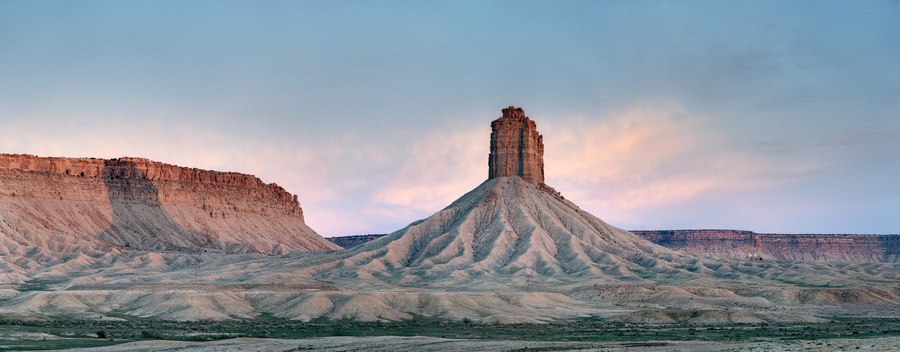
As I drove along Rt-491 in southwestern Colorado, the light faded from Chimney Rock and the cliffs to the east as the sun set. Just before it vanished, I pulled over and quickly took a series of overlapping shots, which I merged into this panoramic.
In the dying glow, the highlighted pillar and its soft-pastel shadows revealed the scene’s subtle colors and textures. As the day grayed into dusk, it reminded me of how haunting these drylands are at this hour; a very different feeling from earlier, when the late afternoon sun created a dramatic interplay of light, shadow, and color.
Formally known as Jackson Butte, in honor of photographer William Henry Jackson, who documented this region on glass plates in the late 19th century, it is now commonly referred to as Chimney Rock. From a distance, it appears to be a volcanic neck, formed when magma hardens within the vent of an active volcano and later becomes exposed by erosion. In fact, the 900-foot-tall pillar is made of Point Lookout Sandstone, a sedimentary formation found in New Mexico and Colorado. It is lithified sand, a remnant of a beach that bordered an ancient sea that divided western North America. The tower’s base is made of softer, slope-forming Mancos Shale, which originated deep beneath the same sea from clay and mud. As the land rose, these sedimentary rock layers eroded into the plateaus and canyons of today’s red-rock country.