
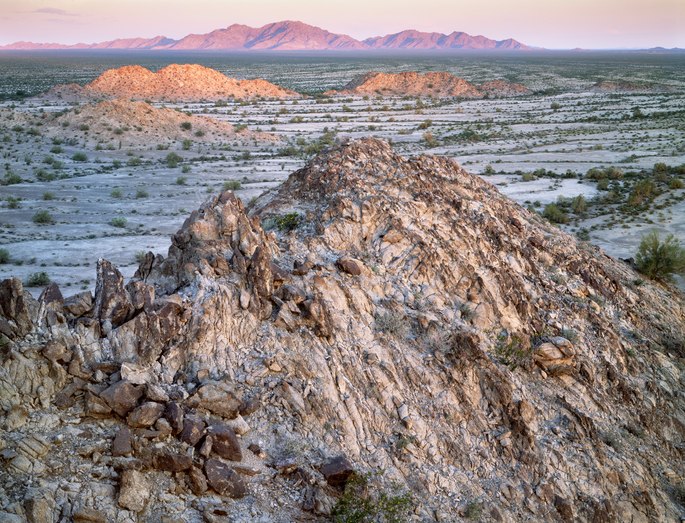
The Intermountain West is a high-desert region that lies between California’s Sierra Nevada to the west and the Rocky Mountain chain to the east. Its geologic centerpiece is the Basin-and-Range country, a series of north-south valleys and mountain ranges that corrugate the earth’s surface from Arizona to Oregon, formed by the push and pull at the intersection of the massive North American and Pacific Ocean tectonic plates.
For this photograph, I stood atop the northern tip of the Sierra Pintas, a range that rises from the floor of Arizona’s Tule Desert to its 2,200-foot ridge. I climbed a hill of light-speckled granite, and as the sun set behind me, I aimed my view camera eastward across a wide, flat basin toward the red-lit cordillera etching the horizon. What lay between was the accumulated clay, gravel, and rock eroded from once-loftier mountains. A place of blessed solitude, these flat drylands felt like an inland sea.
I camped there two decades ago as part of a group exploring the Goldwater Air Force Range to the north and the Cabeza Prieta National Wildlife Refuge to the south. Together, they encompass the otherwise empty southwest corner of Arizona. Scattered stands of palo verde, greasewood, ironwood, and other desert trees dot the landscape along the arroyos that carve through an undulating terrain. During most of the year, the ground has the color, texture, and hardness of concrete. Though it appears uninhabitable, it is the traditional territory of the O'odham Tohono people, who have continued to dwell, cultivate, and collect plants on this otherwise unsettled land for several millennia.