
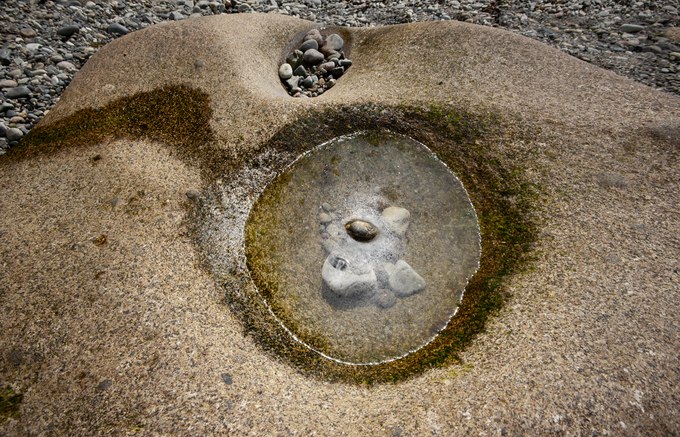
Little Hunter’s Beach is sheltered by Mount Desert Island’s cliffs on Maine’s mid-coast. The strand’s thick layer of granite stones, each pockmarked with splinters of older rock, is tumbled smooth by relentless waves and ferocious nor’easters. On this calm day, the late-summer sea's quiet voice was rhythmic and pulsing. Each incoming wave rolled stones up the beach, creating a chorus of mid-pitched clatter as the round stones bumped together. Then the retreating wave towed them down toward the tideline, producing a symphony of high-note clinks.
A volcanic explosion in the distant past created this coastline's complex geology when parts of North America and northern Europe were a single continent called Avalonia. That era produced the beach's unique formations. Its north side is lined with an undulating wall of dark diabase rock, smoothed into sculptural forms reminiscent of the work of Barbara Hepworth and Henry Moore. On its south side, enormous blocks of fractured sedimentary rock are embedded with granite intrusions, fused by the earth’s heat and pressure.
Near the shoreline at the center of this beach, I photographed a large, smooth boulder that appeared to have emerged from beneath the stones, holding a small, oval pool of crystalline water that cradled a collection of stones. The reflected sun radiated light as though emanating from within the pool, like a searching eye observing the sky and the encircling cliffs.