
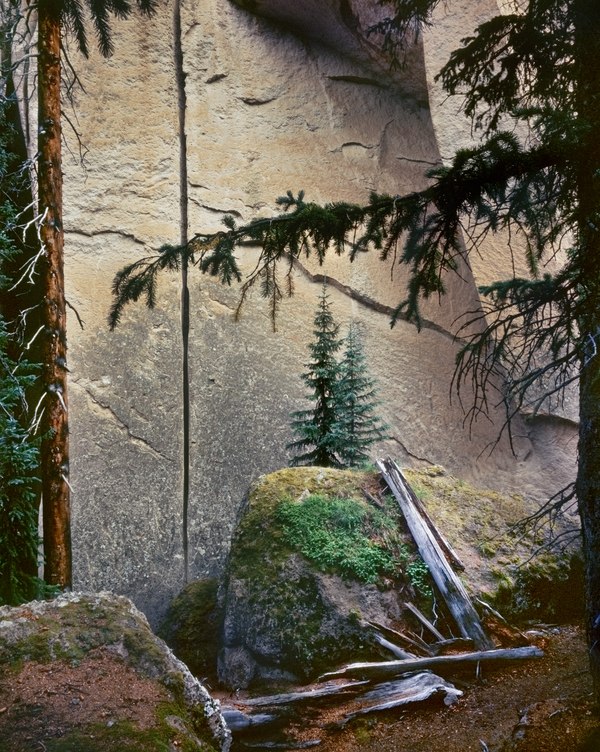
Hidden in the recessed alcoves of dun-toned canyons near the treeline in southern Colorado’s La Garita Range are tableaus of rocks, trees, and moss. Shaped by erosion and lit by the fading light of late afternoon as it settled on rotting trunks and eroding canyon walls, they suggest the remains of ancient ruins, resembling a castle of worn turrets and eroding firmaments.
The cracks, ripples, and shearing of these walls result from fracturing caused by rain, snow, and ice, as water cycles between its liquid and solid states, entering and then wedging rocks apart, eventually causing them to tumble and erode further.
In the distant past, a volcanic explosion, one of the largest worldwide, deposited a hot flow of ash that compressed and cooled into a layer of tuff thousands of feet thick, soft enough to erode easily, capped by harder volcanic breccia, which helps preserve these narrow, cavernous ravines and clusters of spires.
In 1908, recognizing its unique geology, Theodore Roosevelt designated the Wheeler Geologic Area a national monument, and it became, for a time, a popular, if remote, tourist destination. After the Second World War, visitation dropped dramatically, and it was reclassified as a “geologic area” by the Forest Service. Today, it is accessible either by a very rough four-wheel-drive road or by hiking several miles through the high country. Within the confines of its square-mile reserve at 11,000 feet, this naturally sculpted landscape remains, with sheltered spruce groves, a clear stream, and sites to pitch a tent, as my wife and I did when we camped and I took this photograph decades ago.