
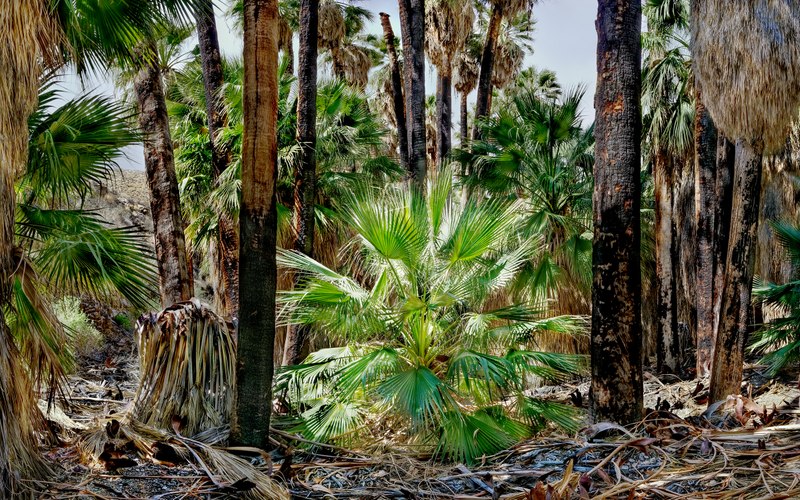
Even in February, temperatures in Palm Springs, California, can soar. On one such hot day several years ago, I hiked a favorite path along shaded Palm Canyon Creek. Surrounded by thick groves of California Fan Palms, these ‘trees’ thrive on the creek’s water. On that day, the current flowed at the surface as it usually does during the winter, and the saturated soil beneath the creek bed nourishes them in the dry season.
The steep, rocky canyon lies in otherwise barren desert country east of the 11,000-foot San Jacinto Mountains, the northern terminus of a chain of ranges that form the long spine of Mexico's Baja California peninsula. Palm Canyon is located on the Agua Caliente Band of the Cahuilla Indians Reservation a few miles south of Palm Springs.
The California Fan Palm (Washingtonia filifera) is the only palm native to the western United States, and its largest natural stand is in this canyon. Often described as a tree, the palm is a flowering plant more closely related to grasses. It grows around desert oases such as this stream, fed by fresh snowmelt from the nearby mountains.
The leaves of the California Fan Palm, called fronds, are durable and slow to decay; the Cahuilla used them to make sandals, thatch roofs, and baskets. If not removed by wind or trimmed by human hands, the dead gray-brown fronds will cover their entire trunks, forming, as they do in this canyon, petticoats that shelter small birds and invertebrates. Fallen fronds mat the canyon floor and can easily ignite fires that periodically blacken the palms' trunks and foster reproduction.